
|
|
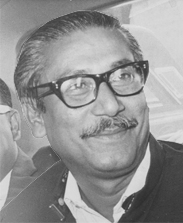
Sheikh Mujibur Rehman
Sheikh Mujibur Rehman was born on 22, March 1922 at Faridpur (East Pakistan). He was an active member of Muslim League organization in pre-Independence India. After independence Mujibur Rehman remained active in politics and was arrested on March 1948, when he was a law student, for leading a black –flag demonstration against Jinnah on the issue of making Bengali as the state language. He along with H.S.Suharawardy organized the Awami League in 1949 .In 1949 he was elected as member of the provincial Assembly and later elected as member of the National Parliament. Twice he became the Minister in the government of East Pakistan. He also led the Parliamentary delegation to the Peoples Republic of China .He was arrested on October 12,1958 for one and a half year and later again in 1962 on the eve of the proclamation of the constitution, for six months.
After the death of Suharawardy, the Awami League was again revised by Mujibur Rehman as a political Party in January 1965. This time to fight the Presidential elections as a component of the combined opposition party, which nominated Miss Fatima Jinnah as the opposition candidate for the Presidential Post against the candidature of Ayub Khan.
During the war of 1965 he condemned the Indian aggression, he and his party gave full support to the governments war efforts. It was in 1966 at an all party national meeting convention in Lahore he gave his six- point program as the constitutional solution of East Pakistan’s problems vis-à-vis those of West Pakistan. He was arrested a number of times in 1966 and was kept under detention for 21 months .He was trailed in the Agartala conspiracy case on June 18,1968.
After the end of Martial Law by Yahya Khan elections were held on December 7,1970 to transfer power to the elected representatives of the people. Two major regional parties emerged on the scene, Mujibur Rehman with his Awami League and Zulfiqar Ali Bhutto with PPP. Mujibur Rehman’s Awami League (AL) contested the elections on the six-point programme. The six-point formula meant that both the wings of Pakistan would be united in a loose federation. As time went by, the speeches of the Awami League leaders became more and more anti West Pakistan. In East Pakistan Awami League returned with a clear majority winning 160 out of the total of 300 seats in the National Assembly. In East Bengal, the Awami League won all but two seats (160 out of 162). In west Pakistan Pakistan’s Peoples Party got the majority. Differences arouse between the government and the Awami League on the transfer of power on the bases of the six-point formula. Both Bhutto and Mujeeb disagreed on the six-point formula, taxation and foreign trade. There was a political deadlock and talks ended in a failure with the postponement of the first session of the National Assembly. A military operation was launched and Mujibur Rehman announced a parallel government on 7th March 1971. With the help of Indian intervention, a new country of Bangladesh was born in blood on 16th December 1971.
The country’s initial government was formed in January 1972 under the leadership of Sheikh Mujibur Rehman, who became the Prime Minister .In early 1975 Mujibur Rehman became the President under a remodeled constitution that granted him virtually dictatorial power. He was unable to stabilize the political situation, however, and was killed in a military coup on 15th August 1975 at his residence. Khandaker Moshtaque Ahmed was made the new President of Bangladesh
